
Some evenings, the most appealing thing on the bathroom shelf is not another acid or a stronger serum. It is a formula that feels easy to wear: a light layer of hydration, a comfortable cream, one less reason to keep touching your face.
That is the territory where centella asiatica and madecassoside have found a place in Korean skincare. They turn up under the familiar cica label, but those names are not interchangeable. A centella extract, an isolated centella compound and a multi-ingredient cica blend can sit in very different formulas.
The useful question is not simply whether a bottle contains cica. It is what else comes with it—and whether that complete formula suits what your skin needs today.
Centella, madecassoside and cica: three labels to untangle
Centella asiatica is the plant, also known as gotu kola. On a cosmetic ingredient list, Centella Asiatica Extract refers to an extract of that plant. Different extraction methods and specifications can produce different compositions, so two extracts do not necessarily contain identical amounts of its individual compounds.
Madecassoside is one of the plant’s triterpenoid compounds. Other names you may see include asiaticoside, asiatic acid and madecassic acid. A product can list centella extract, madecassoside, or both; listing the compound separately gives you more specific ingredient information, but does not establish how much is present.
Cica is a skincare label, not a single standardised formula. One cica product may be a watery ampoule. Another may combine centella compounds with niacinamide in a cream. A third may include exfoliating acids in a toner pad. The shared label does not make their jobs—or their tolerability—the same.
Why an extract percentage is not a strength ranking
A large extract percentage looks reassuring on a front label. It is less useful as a universal measure of performance. The percentage of a botanical extract is not the percentage of madecassoside, and it does not tell you the concentration of every compound within that extract.
Nor does an ingredient name establish that the finished product has been tested for a particular result. If a formula suits your skin, the texture, supporting ingredients and consistency of use matter more than winning a numbers contest on the packaging.
What the research does—and does not—say
A review of centella in cosmetology describes research on centella extracts and their triterpenoid compounds, including work involving inflammation-related pathways and collagen synthesis. Its evidence includes laboratory and animal experiments as well as human studies using particular preparations.
That distinction matters. Research on a compound, a medical preparation or a combination formula is not proof that every cica cosmetic delivers the same effects. It is not a reason to use an ordinary serum on a wound, treat a skin disease with a moisturiser, or expect old scars to disappear.
For everyday cosmetic care, keep the ambition grounded: choose a formula designed for comfortable hydration and use it within a routine your skin tolerates. Persistent burning, a spreading rash or ongoing redness deserves professional advice rather than another soothing-product experiment.
The review also reports contact reactions. Plant-derived does not mean allergy-proof, and a sensitive-skin label is not a promise that a product will suit everyone.
Two ampoules for a light hydration step
COSRX Centella Aqua Soothing Ampoule
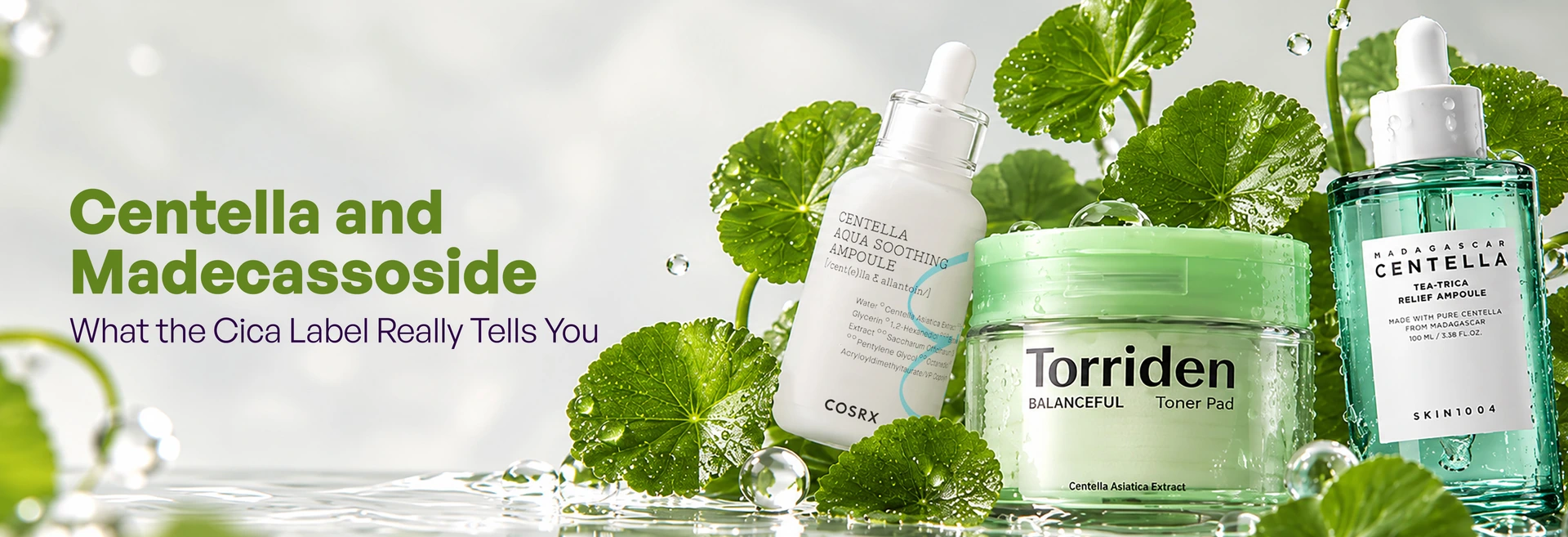
The COSRX Centella Aqua Soothing Ampoule makes the extract-versus-compound distinction especially easy to see. Its formula includes both centella extract and madecassoside, alongside glycerin, panthenol and allantoin.
It has a lightweight, non-sticky texture. That makes it a useful option to consider when you want a hydration layer without turning the whole routine into a rich cream sandwich. Apply it before moisturiser; do not assume an ampoule can replace the moisturiser your skin still needs.
SKIN1004 Madagascar Centella Ampoule
The SKIN1004 Madagascar Centella Ampoule takes an extract-led approach. It pairs centella extract with a hydrating, non-sticky format.
Its Madagascar name refers to the botanical sourcing story, not the nationality of the brand: SKIN1004 is a Korean skincare brand. More importantly for choosing between bottles, an extract-led product is not automatically stronger or weaker than one listing madecassoside separately. Consider the complete formula, your existing routine and your own experience of it.
When the supporting ingredients change the choice
SKIN1004 Madagascar Centella Tea-Trica Relief Ampoule
The Tea-Trica Relief Ampoule combines centella with tea tree ingredients. Designed for oily, blemish-prone skin, its formula includes tea tree leaf water and leaf oil.
This is not simply the plain centella ampoule in another bottle. If you already know that tea tree products agree with your skin, its oil-care positioning may be relevant. If botanical oils have caused discomfort before, or your skin currently stings with most products, the cica label should not override that history. Patch-test and introduce one new product at a time. It is cosmetic care, not a replacement for acne treatment.
SKIN1004 Madagascar Centella Teca Cream
The Madagascar Centella Teca Cream contains centella extract, madecassoside and niacinamide. It is a cream-format option for someone who wants centella ingredients in the moisturising stage rather than another separate serum.
Choose it when you prefer centella-focused care in a cream, with niacinamide alongside the cica ingredients. Consider how comfortably it fits your moisturising step and layers with the rest of your routine.
Cica can appear in exfoliating and cleansing products, too
Torriden Balanceful Cica Toner Pad
The Torriden Balanceful Cica Toner Pad combines centella and madecassoside with an exfoliating role. Its formula includes gluconolactone, a polyhydroxy acid, as well as panthenol and sodium hyaluronate.
That makes this a different purchase from a straightforward hydrating ampoule. If you already use an exfoliating toner, consider whether the pad would duplicate that step. Wiping also adds friction: a cica-containing pad is not a reason to keep rubbing skin that feels raw or sore.
When your skin is uncomfortable, simplifying may be the better choice than trying to balance more exfoliation with more soothing ingredients.
Torriden Balanceful Cica Pore Control Pack Cleanser
The Balanceful Cica Pore Control Pack Cleanser is a two-in-one clay pack cleanser. Its formula includes centella compounds, ceramide NP and capryloyl salicylic acid, also known as LHA.
This is a rinse-off cleansing product, not a substitute for a leave-on moisturiser. Follow the packaging directions for its intended use rather than extending contact time because the formula contains cica. If cleansing leaves your skin tight or uncomfortable, reassess the cleanser and how you use it; adding another ampoule is not necessarily the answer.
Build around one useful step, not six matching labels
You do not need all the products above. They illustrate how widely a single ingredient family can travel across a routine.
- For an extra hydration layer: consider one ampoule before your usual moisturiser.
- For centella in the moisturising step: consider a cream rather than automatically adding both a cream and a serum.
- For oil-care or texture-care needs: examine the tea tree, acid and cleansing ingredients as carefully as the centella ingredients.
- For skin that is currently uncomfortable: prioritise a short, tolerable routine and avoid unnecessary exfoliation or rubbing.
Start with one new product, patch-test according to its directions, and leave time to assess it before adding another. Continue your usual daytime sun protection. If you use prescription skincare or have a diagnosed skin condition, ask your clinician how a new product should fit.
The takeaway: read past the word cica
Centella extract and madecassoside belong to the same ingredient story, but they tell you different things about a formula. Neither name can tell you, on its own, whether a product will suit your skin.
The better purchase is the one with a clear job: an ampoule for a light hydration step, a cream for the moisturising stage, or a cleansing or exfoliating product chosen with its additional ingredients in mind. Cica is a helpful signpost. The rest of the label still deserves your attention.